Classics
Prairie Fire Publishing recognizes these texts as classics of the ideology of the international proletariat. These works emerged as revolutionaries applied the ideology to transform reality through practice, which further developed and deepened it. We believe providing these works to a broad audience at an affordable price is essential.
Other Works
Prairie Fire Publishing considers these texts to be important works of a progressive nature. They express the thinking and practice of broad sectors of the masses arising from popular struggles around the world.
Pamphlets
Prairie Fire Publishing makes revolutionary and progressive literature available to everyone by offering free, downloadable pamphlets that can be easily printed and assembled. This simple approach means that revolutionary ideas and educational materials can reach more people, as the only cost is the minimal expense of printing and binding. By removing the price barrier and making these materials easy to reproduce, we help build a foundation for revolutionary education where anyone can access, study, and share these vital texts.
Class Struggle in the U.S.

Browse our latest titles
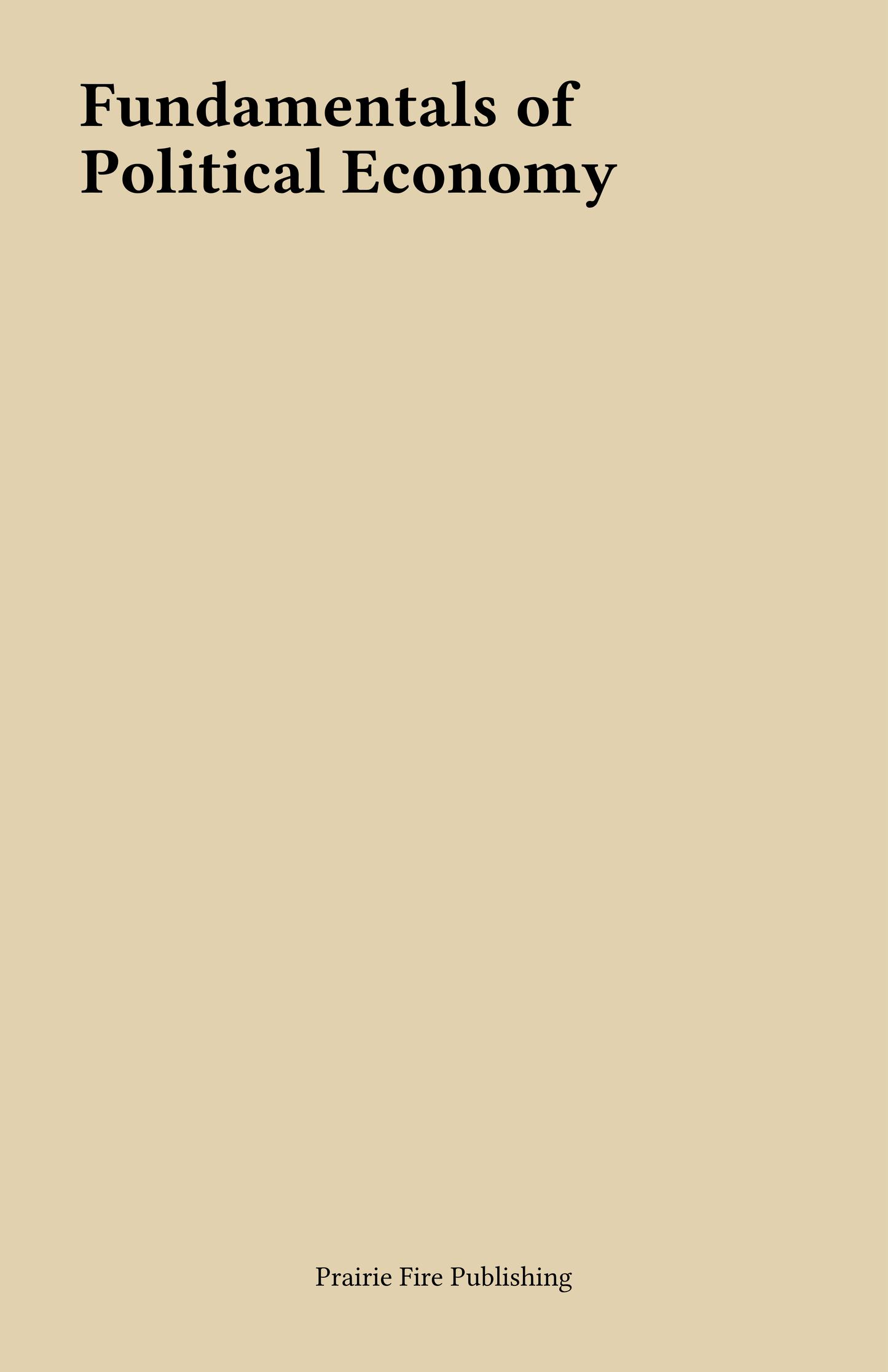
Fundamentals of Political Economy
Compiled here into a single volume, Fundamentals of Political Economy is a Great Proletarian Cultural Revolution-era textbook that covers both capitalist and socialist political economy. The first half outlines the object of political economy — relations of production — and then summarizes Marx's magisterial three-volume Capital, as well as Lenin's theory of imperialism as the highest stage of capitalism. In the second half the book expounds in detail upon Chairman Mao's deep development of the political economy of socialism, including an outline of the economic transition to Communism, the class struggle and contradictions of socialism, and a penetrating criticism of capitalist restoration in the Soviet Union.

Science Advances
Between 1940 and 1944 J. B. S. Haldane wrote a science column for the Daily Worker (UK). Science Advances gathers eighty-two of these essays — most from that column, the rest from the New Statesman, Science and Society, and Nature. In two or three pages each they take up Newton and Marx, flying ants and bird migration, the common cold and the first antibiotics, colliery explosions and factory ventilation, polarized light and the electron microscope. Haldane was among the foremost geneticists of his century and wrote here for a working-class readership, refusing to treat the two facts as being in any tension. "For this book is definitely a social product rather than the efflorescence of my own mind."

Permanent Counter-Revolution
Written in his characteristic style, William F. Dunne presents a scathing indictment of the Trotskyite leadership during the two Minneapolis strikes of May and July 1934. He argues that these leaders, for all their revolutionary posturing, betrayed a disciplined and militant rank and file; first by smothering a general strike the workers had already voted for, then by shielding reactionary Governor Floyd B. Olson as he declared martial law, raided the union hall, and issued the permits that broke the strike. Dunne closes by insisting that only the Communist Party correctly identified the Farmer–Labor administration as an instrument of capitalist rule, and that these lessons must be raised to the Minneapolis workers before the struggles ahead.

Gastonia
William F. Dunne wrote this book from the mill district itself, with the case against sixteen textile workers still being built and thirteen of them facing the electric chair. Dunne presents the Loray mill of the Manville–Jenckes Company as the citadel of an industrial South sold to Northern capital on the promise of cheap labor. The strike that carried the National Textile Workers Union inside it was deliberately weaponized to justify the offense of murder charges in an attempt to punish the rebellious workers. Against sixteen prisoners the mill owners set a prosecution staff of sixteen attorneys, paid from a fund raised to smash the union. Dunne closes in the words of a Loray mill worker, and reads the case as the South's Haymarket — the emergence of the Southern working-class as an integral part of the American proletariat.